
Shove or Fold
How to read the "Shove or fold?" step in a tournament hand review: which decision earns more in money and in bb, where ICM and bounties come from, what the equilibrium range grid shows and what the answer rests on.
With a short stack in a tournament, the hand review adds a “Shove or fold?” step. It compares the two decisions you had and counts which one earns more: in money when the tournament allows it, in chips otherwise.
The step appears only in tournaments and only preflop: when you decide whether to move all-in with an effective stack of up to 15 bb, and when you answer someone else’s all-in with up to 25 bb.
The answer: which is worth more, and by how much
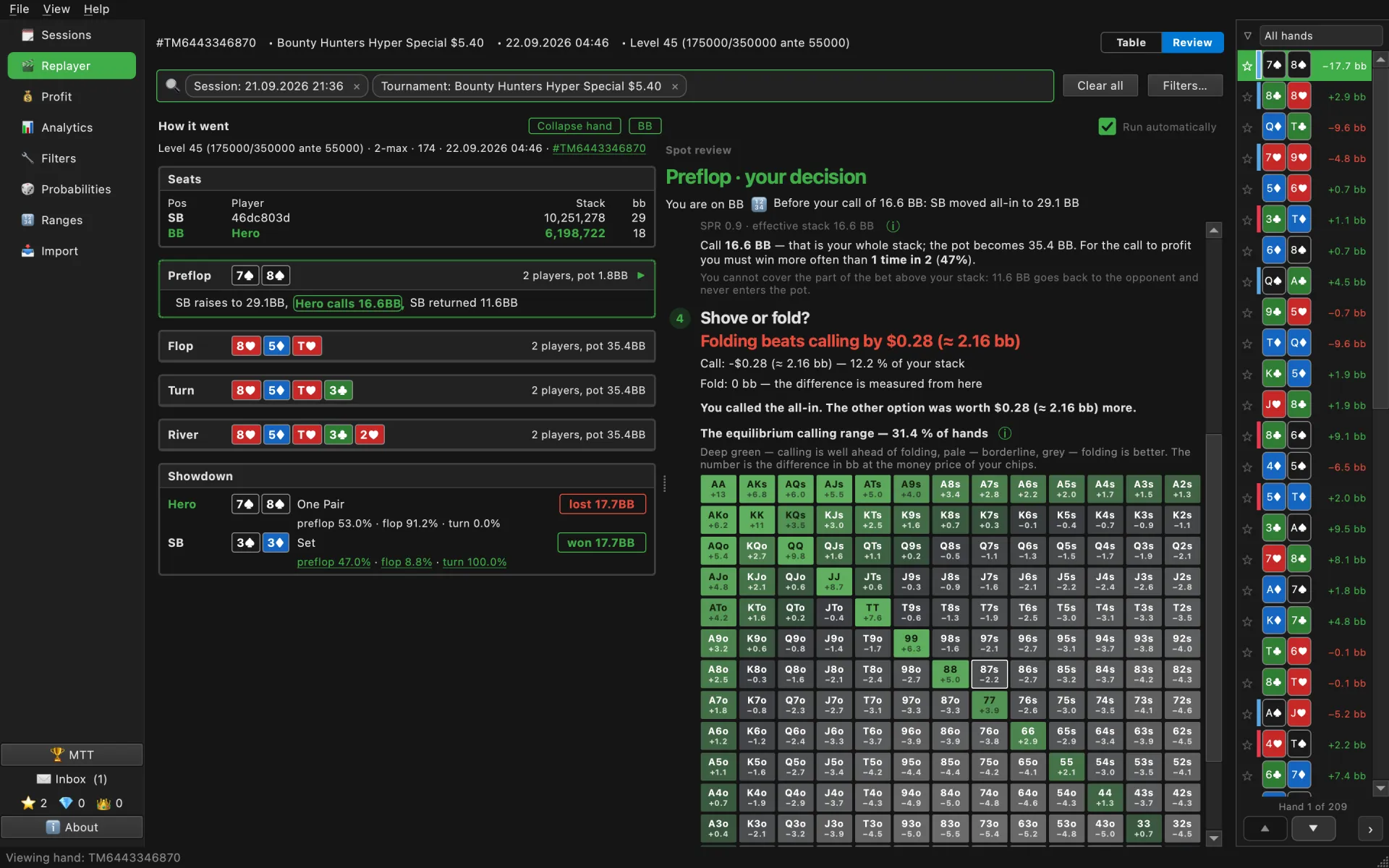
- The headline names the difference. “Folding beats calling by $0.28 (≈ 2.16 bb)”: money when the tournament has a summary, and the same money in big blinds. Without a summary the answer is in bb.
- The two lines below price each decision on its own. Folding is zero, which is what the difference is measured from, and calling here is −$0.28, or 12.2 % of your stack.
- The last line says what you did. “You called the all-in. The other option was worth $0.28 (≈ 2.16 bb) more.” When the difference is under 0.05 bb, the spot is called a coin flip.
Money is priced by this tournament’s ICM: its payout ladder and the number of players left, plus opponents’ heads in a PKO. When the tournament’s ladder is saved, that one is used; otherwise it is a typical ladder for a field of that size. The screenshot is heads-up, and the line under the grid says that payouts and bounties do not change the answer here.
The grid: the equilibrium range
“The equilibrium calling range — 31.4 % of hands” is the set of hands that call no worse than they fold, assuming the opponent plays at equilibrium too. Each cell holds the difference between calling and folding, in bb at the money price of your chips. Deep green means calling is well ahead, pale means borderline, grey means folding is better. Your own hand is ringed: 87s at −2.2 here. When the decision is whether to shove, the grid is red and shows the shoving range.
Under the grid, a line names the effective stack, the ante, the number of players and what the answer was priced by. “Show the opponents’ ranges” opens what each opponent continues with.
What this answer rests on
The collapsed block at the bottom lists the assumptions behind this particular hand, each with the direction it can move the answer. For example, the payout ladder may be a typical one rather than the real one. The number of players left is estimated from the average stack at your table. In a PKO every opponent’s bounty is taken at its starting value. At most two opponents answer the all-in, and folded cards are treated as still in the deck.
The step counts and shows the difference; it does not say how to play. An equilibrium describes play that cannot be punished, not how a particular opponent calls.
→ See also: Tournament Payouts and Knockouts, Strategy Fit.