
Hand Review and Ranges
How the hand review window in BluffLog works: four questions for every decision, where the opponent's range comes from and how it is narrowed, what the equity bar and the outs mean, and what the Ranges page is for.
The profit and analytics screens tell you that money leaks; this window tells you where in a hand. It opens from any hand in your database and answers four questions about the decision you are looking at, with the opponent’s range built from a chart and narrowed by what he actually did. The screenshots are from version 0.18.1; click one to see it full size.
Opening a hand
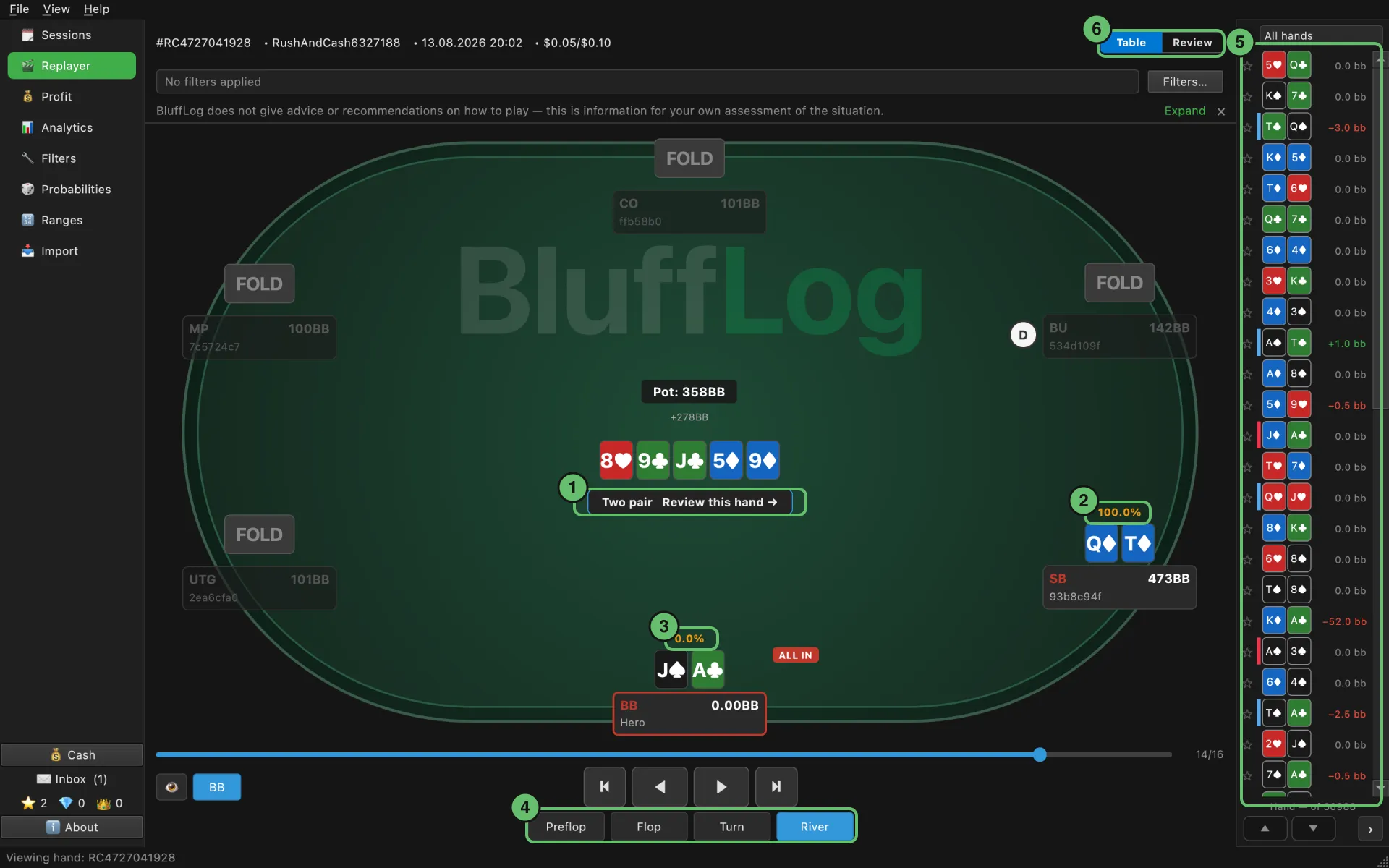
- The plaque under the board names your hand at this street. Click it, and the review window opens for this exact decision.
- The equity of the player whose cards are known is shown next to the cards. Here it is 100% against 0% on the river: the hand is already decided.
- Your equity at the same moment. Compare the two numbers street by street to see where the hand was lost.
- Street buttons move the whole table to the flop, the turn or the river; the review follows the street you are on.
- The list on the right is the hand list you came from, with the result of each hand in big blinds; the arrows at the bottom step through it without going back. A strip left of the cards says whether the hand was played in or outside the strategy preflop; see Strategy fit.
- Table / Review switches the replayer: in Review the same lesson takes the table’s place, and you step through the hands with it.
Any hand from a session or a hand list opens here; a star marks it for later.
The review window
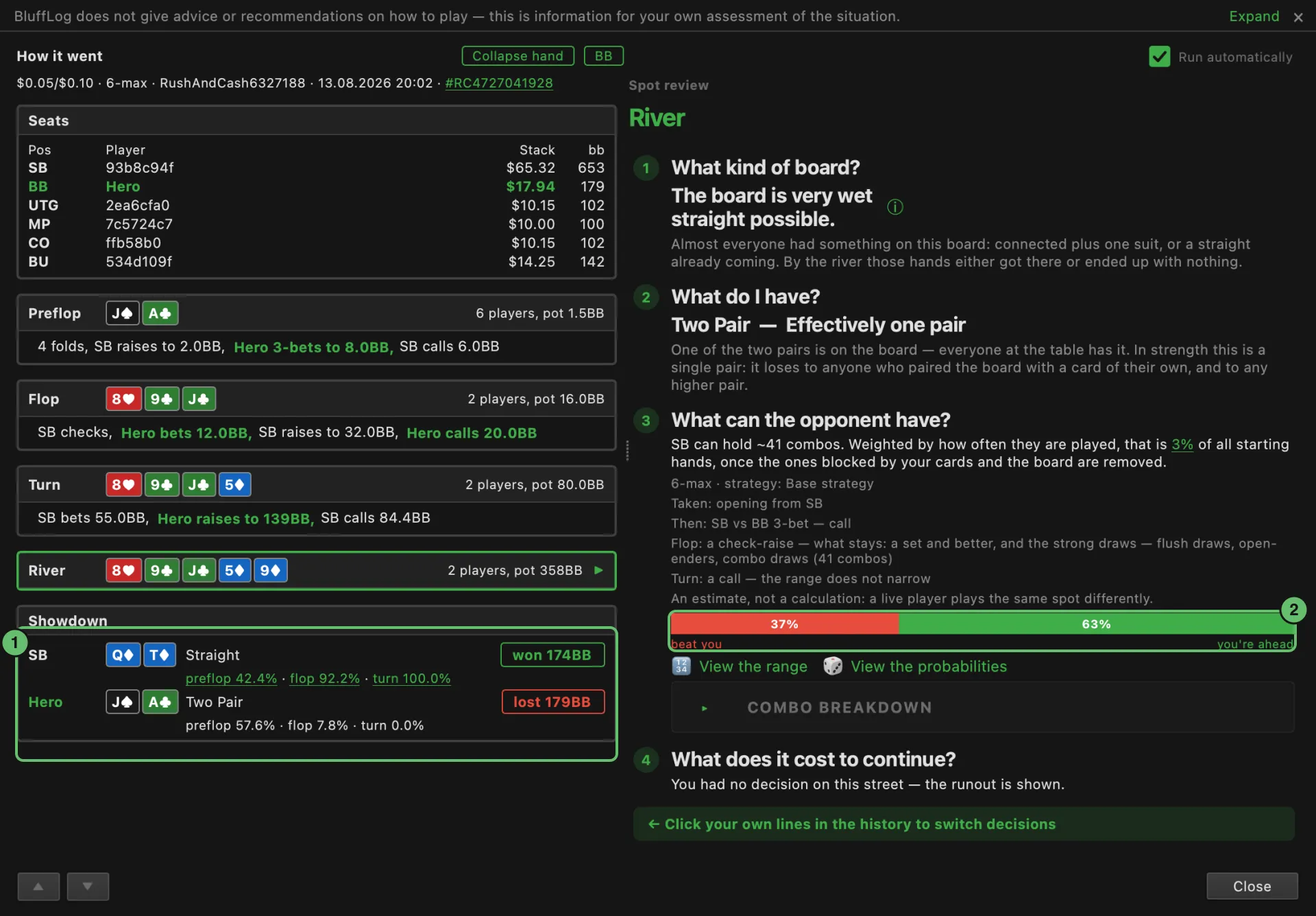
- Showdown with equity by street. The left half is the hand as it went, your actions in green. The showdown block is the most useful line in it: preflop 57.6%, flop 7.8%, turn 0.0% means that the hand was decided on the flop, not on the turn where the money went in. Read this line first; it says which street to review.
- The equity bar splits the opponent’s range into three: hands that beat you, hands that chop, hands you are ahead of. “Show the range” opens the grid behind the bar; “Combo breakdown” lists which hands those are. The takeaway line under it says which side you are on and with what equity.
The right half asks four questions, numbered by the window itself.
- What kind of board. Dry, semi-dry, wet or very wet, judged from the board alone: suits, how close the ranks sit, whether a straight is already possible. The wetter the board, the more it costs to let the opponent see the next card and the less being ahead right now is worth.
- What do I have. Not the name of the combination but its class in this spot: overpair, top pair, bluff-catcher, draw, strong made hand, air. Each class comes with the question that actually matters for it; for a strong made hand that is not “call or fold” but “how to get the most out of it”.
- What can the opponent have. The range starts from the chart for this format and position on the Ranges page, then each action narrows it: a raise leaves a strong made hand or a draw, a call leaves hands with something and removes the ones with neither a pair nor a draw. The combo count is stated after the hands blocked by your cards and the board are removed, which is why the percentage is lower than the same chart shows on the Ranges page. Every narrowing is labelled as an estimate, not a calculation: a live player plays the same spot differently.
- What does it cost to continue. The call, the pot after it and the equity you need for the call to profit; SPR and the effective stack next to it. SPR below 4 means the hand will almost certainly go all-in, so the decision is about the whole hand, not this street.
Preflop the review is shorter: where your hand sits in the chart for this position, what the chart plays with it, and your equity against the range of whoever opened. The first line names the strategy and its answer, so you see whether the hand was played by the strategy. At an all-in in a tournament there is one more step, “Shove or fold?”: which decision earns more in dollars and in bb, with the payouts and bounties counted; more in Shove or fold.
If you are behind: outs
On the flop and turn the window has one more section, on how you improve, and it does not count outs the way a chart on the wall does.
- Real outs are cards that lift your equity against the hands currently beating you. Dirty outs bump your hand category without changing anything against those hands: JJ on 2-9-6 turning a 9 makes two pair, but AA, KK and QQ make the same two pair and sets become full houses. The window counts only the real ones.
- Tainted outs improve you and complete the board’s flush draw at the same time; count them as about half an out. Cards that make the board’s own hand for everyone are not outs at all.
- The next-card map sorts every possible turn or river into improvements, scares and neutral cards, and gives a rough implied and reverse-implied figure: what a hit is worth and what a scare card costs on average. Both are heuristics, and the window says so.
The Ranges page: where the range comes from
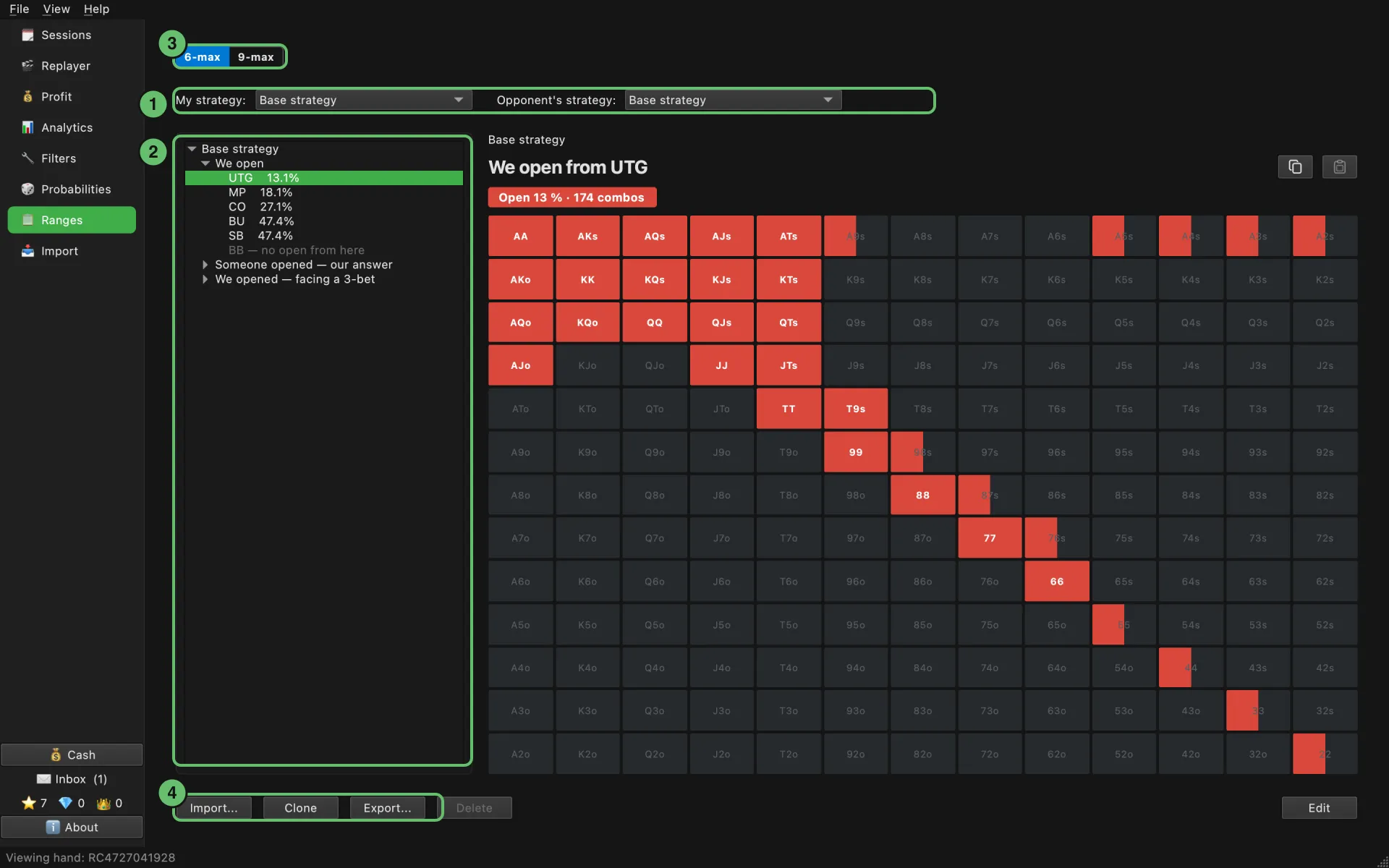
- My strategy and Opponent’s strategy. The first is what the line about your own hand is counted from, the second is where the opponent’s range comes from. If the opponent’s strategy has no chart for the spot, the nearest strategy that has one is used, and the review says so.
- The tree is every spot the review can narrow through: each position opening, defending against an open, facing a 3-bet, with the share of hands in each; in tournaments also stack depths and a separate PKO node. Click a node to see its grid.
- Table size. Cash has 6-max and 9-max, tournaments 6-, 8- and 9-max: each has its own charts, and the review takes the ones that fit the hand’s table.
- Import, clone and export. Clone the built-in strategy, adjust a few spots to your pool, select the copy, and every review from then on narrows from your model. A strategy can be exported to a file and imported back. More in Ranges and strategies.
These are not recommended ranges. The built-in strategy is a rough model of how the micro-stakes field actually plays, and it exists so that the review can compute equity against a realistic opponent. Playing it yourself is not the idea.
Two things the range deliberately does not do. It does not model this specific opponent’s postflop habits; it is a preflop chart narrowed by actions. And in a multiway pot the equity is counted against every opponent in the pot whose chart is found, not only against the one whose bet you are paying.
What to do with it
Do not start with the hands you lost the most on; start with the hands where the showdown line drops sharply on one street. Open the review at that street, read the range and the price, and decide whether the action there was a mistake or a cooler. A dozen hands like that per session is more than most players review in a month.
→ See also: Cash Game Analysis for finding the spots.